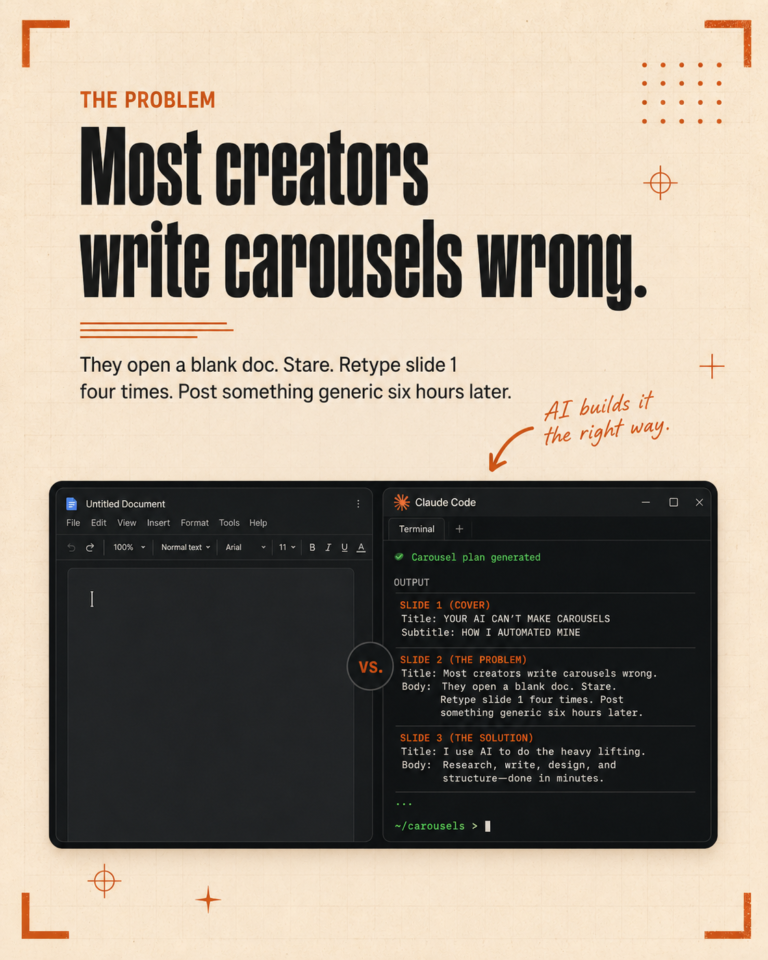
Small businesses get the worst deal in marketing. Big companies have teams. Agencies charge retainers that eat half a small business budget. And the DIY route means spending evenings writing Instagram captions instead of running your business.
AI marketing workflows change this equation. Not the vague “use AI to 10x your results” advice that floods LinkedIn. Real, specific workflows that handle the repetitive parts of marketing so you can focus on the parts that actually need a human brain.
At The Igniting Studio, we build these workflows for our clients and for our own agency. This post covers the specific systems we use, why small businesses benefit the most from them, and how to start building your own.
What an AI Marketing Workflow Actually Is
A workflow is a repeatable process with clear inputs and outputs. You put something in, follow a set of steps, and get a consistent result out.
An AI marketing workflow is the same thing, except the AI handles the heavy lifting in the middle. You provide the input (a video transcript, a client brief, a set of requirements). The AI processes it according to rules you have set. You review and approve the output.
The key difference from just “using AI” is the rules. A workflow has documented voice guidelines, quality checks, formatting standards, and client-specific preferences baked in. You build it once, then run it repeatedly. Each run produces consistent, on-brand output without starting from scratch.
The Workflows We Built (And Use Daily)
Content Creation Workflow
This is the one that saves us the most time. It takes a single piece of source content, usually a video transcript, and produces platform-specific outputs: captions, blog drafts, social posts, video descriptions. Each output follows the client’s voice and platform rules.
Before this workflow existed, repurposing one video into content for multiple platforms took 2 to 3 hours of writing. Now the first draft takes about 15 minutes. We still review and edit everything, but starting from a solid draft instead of a blank page changes the entire workday.
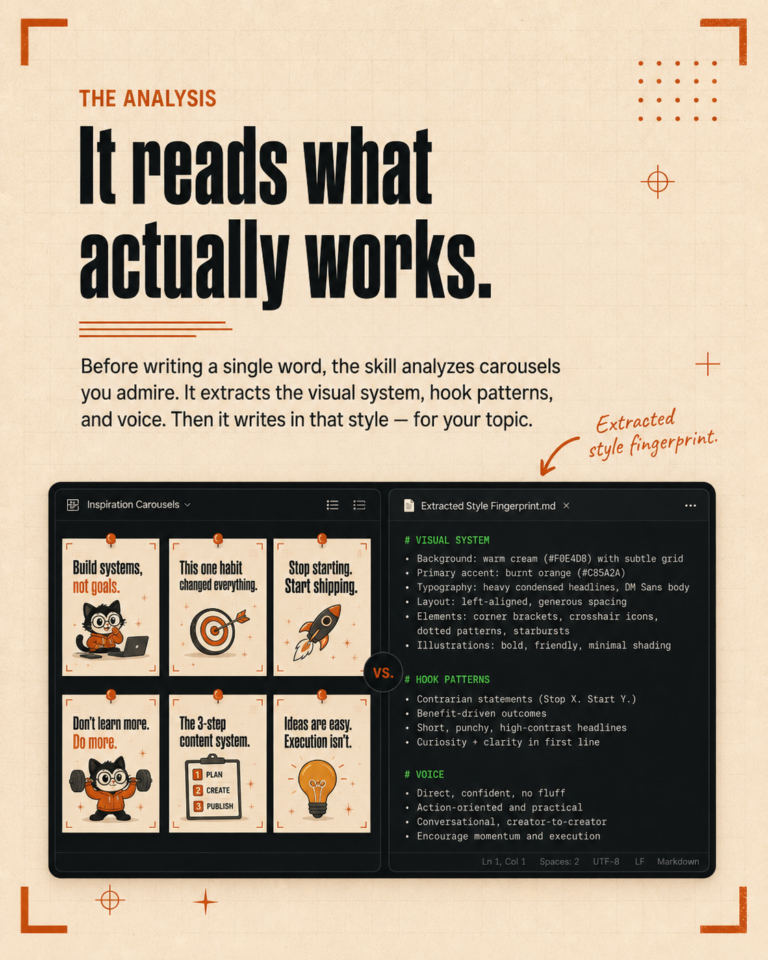
The workflow knows each client’s voice because we documented it in configuration files. When we run it for a local food business, the output sounds warm and casual. When we run it for a professional services firm, it sounds measured and authoritative. Same workflow, different context, right results.
Client Onboarding Workflow
When a new client signs on, there is a long list of setup tasks: document their brand voice, define content pillars, set posting schedules, create their folder structure, write platform-specific guidelines. Doing this manually takes most of a day.
Our onboarding workflow generates most of this from a structured intake. We answer a series of questions about the client (industry, audience, goals, voice preferences, platform focus) and the system produces: a brand voice guide, content pillar definitions, a posting schedule template, and the configuration files that power all other workflows.
Twenty minutes of input produces a comprehensive client setup. We review it, adjust what needs adjusting, and the client is ready to go. The time savings are significant, but the real benefit is consistency. Every client gets the same thorough onboarding, nothing skipped, nothing forgotten.
Reporting Workflow
Monthly client reports used to be one of those tasks that always took longer than expected. Pull data from three platforms, organize it, write commentary, format it, send it. Two hours per client, easy.
Our reporting workflow pulls the data, structures it, and drafts the commentary. The narrative adapts to the numbers: if engagement was up, it explains why. If a post underperformed, it flags the likely reason. We review the report, add any personal observations, and send it.
This is not about replacing the analysis. It is about not spending 45 minutes formatting a table and writing “engagement increased 12% this month” for the fifth time.
Why Small Businesses Benefit Most
Large companies already have teams to handle marketing execution. They have writers, designers, social media managers, analysts. AI workflows speed things up for them, but they already have the bodies to do the work.
Small businesses usually have one person doing everything. The owner, the manager, or a single marketing hire. That person is the strategist, the writer, the designer, and the scheduler. Every hour they spend on repetitive execution is an hour they cannot spend on the work that actually grows the business.
AI marketing workflows give small businesses something they have never had before: execution capacity without headcount. A solo marketer with good workflows can produce the volume and consistency of a small team. Not because the AI replaces thinking, but because it handles the work that does not require original thought.
The Math
Consider a small business that posts 5 times per week across 2 platforms. That is 40 posts per month. At 30 minutes per post (writing, formatting, scheduling), that is 20 hours of work. Add reporting, strategy adjustments, and engagement: 30 hours per month on social media alone.
With a content creation workflow, first drafts take 5 minutes instead of 30. Review and editing add another 10 minutes. That is 10 hours instead of 20 just on content creation. The other 10 hours of strategy and engagement stay the same, because those require human judgment. But you just freed up 10 hours per month from one workflow.
Stack three or four workflows and the savings add up quickly.
How to Start Building Your Own Workflows
You do not need a developer or a complex setup. Here is the practical path.
Step 1: Identify Your Most Repetitive Task
What marketing task do you do most often that follows a predictable pattern? For most small businesses, it is writing social media captions or creating weekly content. Pick that one.
Step 2: Document the Process
Write down exactly how you do it today. What inputs do you need? What steps do you follow? What does a good result look like? What rules do you always follow (brand voice, formatting, hashtags)? Be specific. “Write a good caption” is not a process. “Write a caption under 150 words, starting with a question, using 3-5 hashtags, ending with a soft CTA” is a process.
Step 3: Set Up Claude Code With Your Context
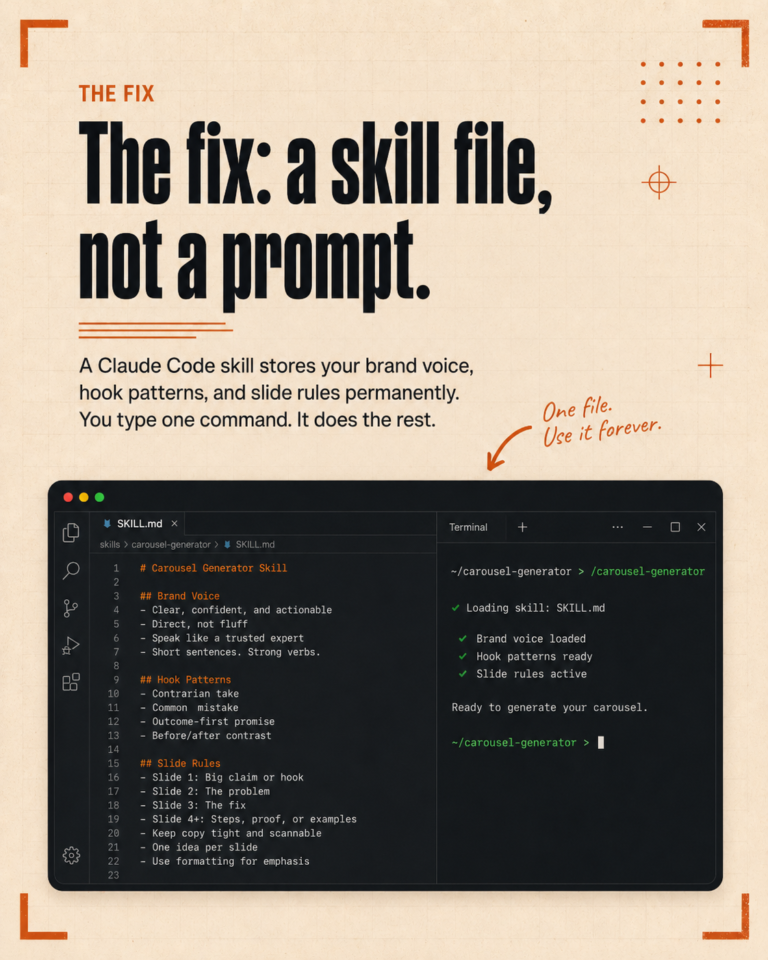
Create a CLAUDE.md file with your brand voice rules, content guidelines, and any specific preferences. This file loads automatically every session, so the AI always has your context.
Step 4: Write Your First Workflow
Turn your documented process into a set of instructions the AI can follow. Save it as a reusable file. Run it on a real task. Compare the output to what you would have written manually.
Step 5: Refine Based on Real Results
The first version will not be perfect. Adjust the instructions. Add rules for things the AI got wrong. Remove steps that are unnecessary. After three or four iterations, you will have a workflow that produces consistently good output.
Step 6: Build the Next One
Once one workflow is running smoothly, pick the next most repetitive task. Each new workflow is easier to build because you understand the process and you already have client context documented.
Common Mistakes to Avoid
A few things we learned the hard way.
- Do not skip the voice documentation. Generic AI content sounds generic. The time you spend documenting brand voice pays for itself immediately.
- Do not publish without reviewing. Workflows produce drafts, not finished work. Human review is not optional.
- Do not try to build everything at once. One workflow, running well, is worth more than five half-built ones.
- Do not expect perfection on day one. Workflows improve over time as you refine the instructions and add rules. Give it a month before judging results.
The Compound Effect
The real value of AI marketing workflows is not the time saved on any single task. It is the compound effect over months. Every workflow you build makes the next one easier. Every client configuration you write improves the output for that client permanently. Every rule you add prevents the same mistake from happening again.
Three months of steady building gives you a marketing system that works harder and more consistently than any manual process. Six months gives you something that fundamentally changes how much one person or a small team can accomplish.
Ready to build your first workflow? Book a free 30-minute call and we will help you identify where to start.