Most articles about AI marketing workflows are written for enterprise teams with full-time data analysts and content production budgets that look nothing like a small business reality. The advice does not translate. A small business operator does not have a content council to align on AI guidelines. They have one person, often the owner, trying to publish consistently while running everything else.
This is the AI workflow shape that actually holds up for a small business operator running real marketing work. Three workflows, each delivering hours of saved time per week, none of them requiring a developer on staff.
Workflow one: weekly content from one source
The most expensive part of marketing for a small business is producing content consistently. The AI workflow that solves it starts with one source piece per week. A long-form video, a podcast clip, a written essay, or a recorded thought. One thing of substance.
That source piece feeds the rest of the week. The transcript is processed through a content engine that produces a LinkedIn post, three short-form video hooks, an Instagram caption, a blog outline, and a newsletter section. All in the brand voice, all formatted for the platform they are going to.
The first time you run this, it takes longer than writing the posts directly. By the third week, the system is running in twenty minutes and producing more output than two days of manual writing did before. The investment is the configuration. The return is everything after that.
Workflow two: client onboarding in one folder
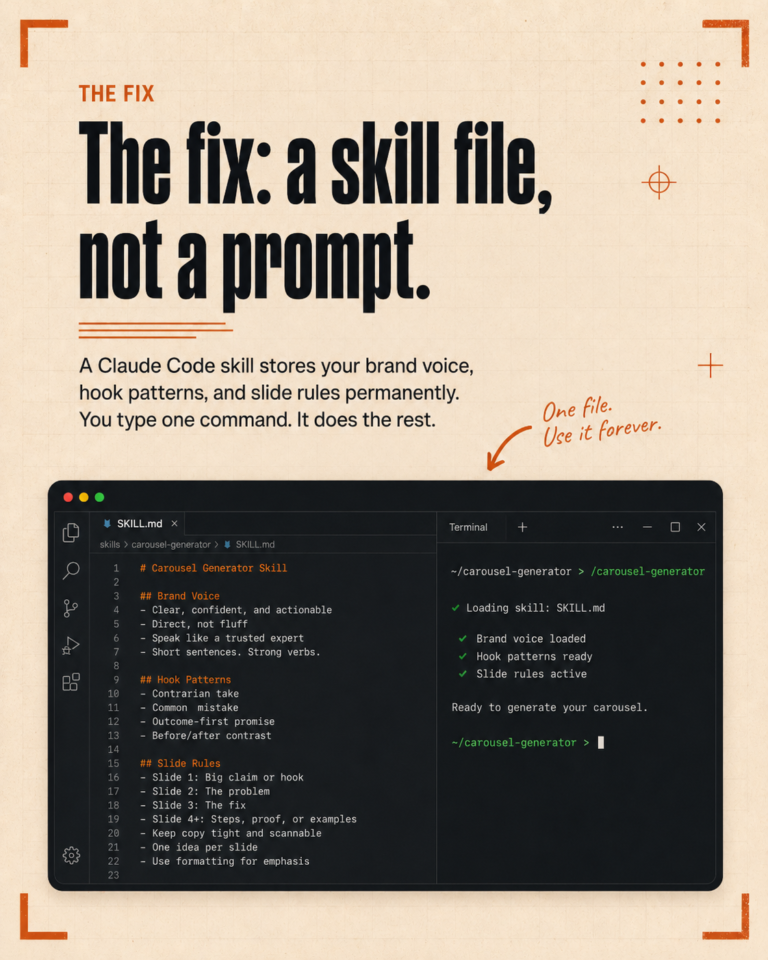
If you serve clients, you know that the first week is where most of the time evaporates. Brand discovery, voice extraction, writing samples, getting the first posts approved. The AI workflow that compresses this is built around one folder per client, with a CLAUDE.md file at the top that captures everything the AI needs to know about the brand.
The folder contains the voice guide, the content pillars, the banned words, past posts, the booking link, the offer language, and the visual rules. Once it is filled in, every AI workflow you run for that client reads from that folder and behaves correctly the first time. New posts go from “draft, review, edit” to “draft, ship” within a couple of weeks.
The compounding effect is real. After ten clients, the onboarding template is sharp enough that a new client can be operational within ninety minutes of the intake call.
Workflow three: reporting that writes itself
The reports your clients want do not change much from month to month. Top performing posts, key metrics, what worked, what did not, what is happening next month. The format is consistent. The data is in the same places. The only thing that changes is the actual numbers and the commentary.
The AI workflow that solves this reads the metrics from a dashboard or a CSV, applies the report template, writes the commentary, and outputs a finished document. What used to be a half day of work per client per month becomes an hour total across the whole client list.
The first version of this workflow will not be perfect. The commentary will sometimes miss what actually mattered, and you will need to edit it. That is fine. After two or three months, the template is tuned enough that the edits become minor.
What ties them together
The pattern across all three is the same. You build the configuration once, you test it under real work, you fix what breaks, and after a few weeks the workflow runs without supervision. This is the part that does not show up in most AI marketing advice, because it is unglamorous. There is no headline like “use AI to write a viral post in five minutes” in any of this. Just a slow shift from manual to systematic.
What changes is what you do with the time you save. For us, the saved time goes back into client work that needs human judgment, like strategy, brand voice tuning, and conversations that AI cannot have. The AI handles the work that should have been a system from the beginning.
Where to start
If you are a small business operator running marketing alone or with a small team, start with workflow one. Pick one source piece per week. Build the content engine around it. Run it for a month before adding anything else. The discipline of doing one workflow well is more valuable than half-building three.
If you want help mapping the right first workflow for your business, book a free call here and we will walk through your current process and where the highest-leverage workflow lives.