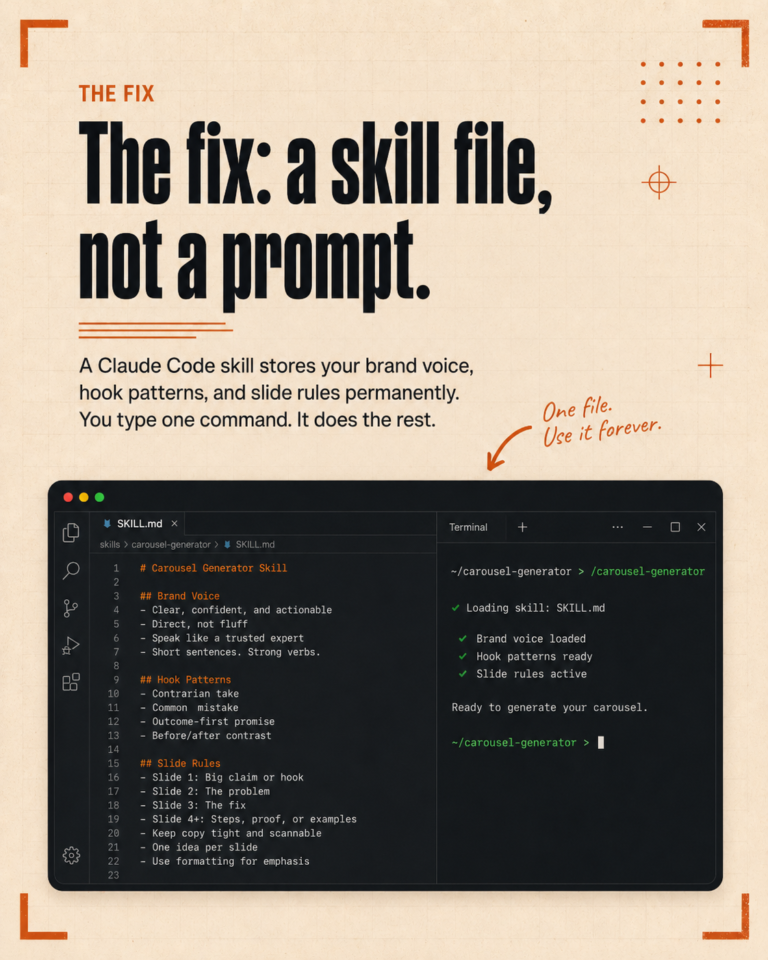
The first thing Claude Code reads when you open a project is a file called CLAUDE.md. Everything in that file becomes a default rule the AI follows for the rest of the session. If the file is empty or vague, the output is generic. If the file is structured well, the AI behaves correctly without reminders, which is what makes it usable for actual client work.
This is the structure we use across every client folder we run, and the logic behind each section.
Section one: who the brand is in one paragraph
Open with a tight description of the brand. Who they serve, what they sell, what makes them different from the closest competitor, and the tone they want to be associated with. Three to five sentences is enough. The goal is to give the AI a working mental model of the brand before any rule kicks in.
Avoid marketing-speak in this section. The AI reads “we are a leading provider of innovative solutions” and gives you back the same kind of language. Write it the way a real person would describe the brand to a friend.
Section two: voice in concrete terms
List five voice traits, each in one or two words: warm, direct, plainspoken, slightly self-deprecating, anti-jargon. Then give two or three example sentences in that voice and two or three counter-examples that sound off-brand. The contrast is what teaches the AI the difference.
If the brand has a real person behind it, like a founder or owner, name them and describe how they speak in interviews. The AI is much better at imitating a specific voice than a generic style.
Section three: words to avoid
Every brand has words it never uses. List them. We have seen real client lists range from twenty to over a hundred. Common categories are corporate jargon (leverage, synergy, scalable), AI tells (revolutionary, game-changing, cutting-edge), and brand-specific words that come from competitor language.
This list is the highest-leverage part of the file. Most AI-generated feel comes from a small set of overused words. Once those are banned, the output sounds noticeably more human within one session.
Section four: content pillars and topic boundaries
List the three to five content pillars the brand actually publishes around. For each pillar, write one sentence describing what kinds of posts fit and one sentence describing what does not fit. The boundary is as important as the topic, because the AI will try to be helpful and will drift into adjacent territory if you do not set the edge.
Include a short list of topics the brand never publishes about. Politics, religion, certain competitors, specific past incidents. The AI will respect the no-go list as long as it is in the file.
Section five: formatting rules
Cover the structural details that show up in every output. Hashtag rules (lowercase or mixed case, how many per post, which platforms get them). Emoji policy (allowed, banned, or limited to a specific set). Punctuation preferences (em dashes, ellipses, sentence length). Link handling (in body, in comments, never in posts). CTA structure for the brand.
Be specific. “Use a casual tone” is not a rule. “Use contractions wherever they fit naturally” is a rule.
Section six: examples of past outputs
End the file with three to five real examples of past content the brand published and was happy with. The AI will pattern-match against these constantly. Examples are more powerful than rules, because they show the rules being applied in practice.
If you can include both a strong example and a weak example with a note explaining why the weak one missed, even better. The contrast accelerates the learning.
How to maintain the file over time
CLAUDE.md is not a one-time setup. Every time the AI produces an output that is wrong in a way the file did not predict, add a rule to the file. Over a few weeks the file becomes a precise description of the brand, and the AI first-pass output approaches publishable quality.
We treat CLAUDE.md as the most important asset in a client folder. The folder structure can change. The skills can be rewritten. The CLAUDE.md is what the AI reads to know who the brand is, and replacing it would mean rebuilding the brand voice from scratch.
If you want help writing a CLAUDE.md for your brand or your client, we run a short setup call where we go through the actual file together. Book a free call here.